

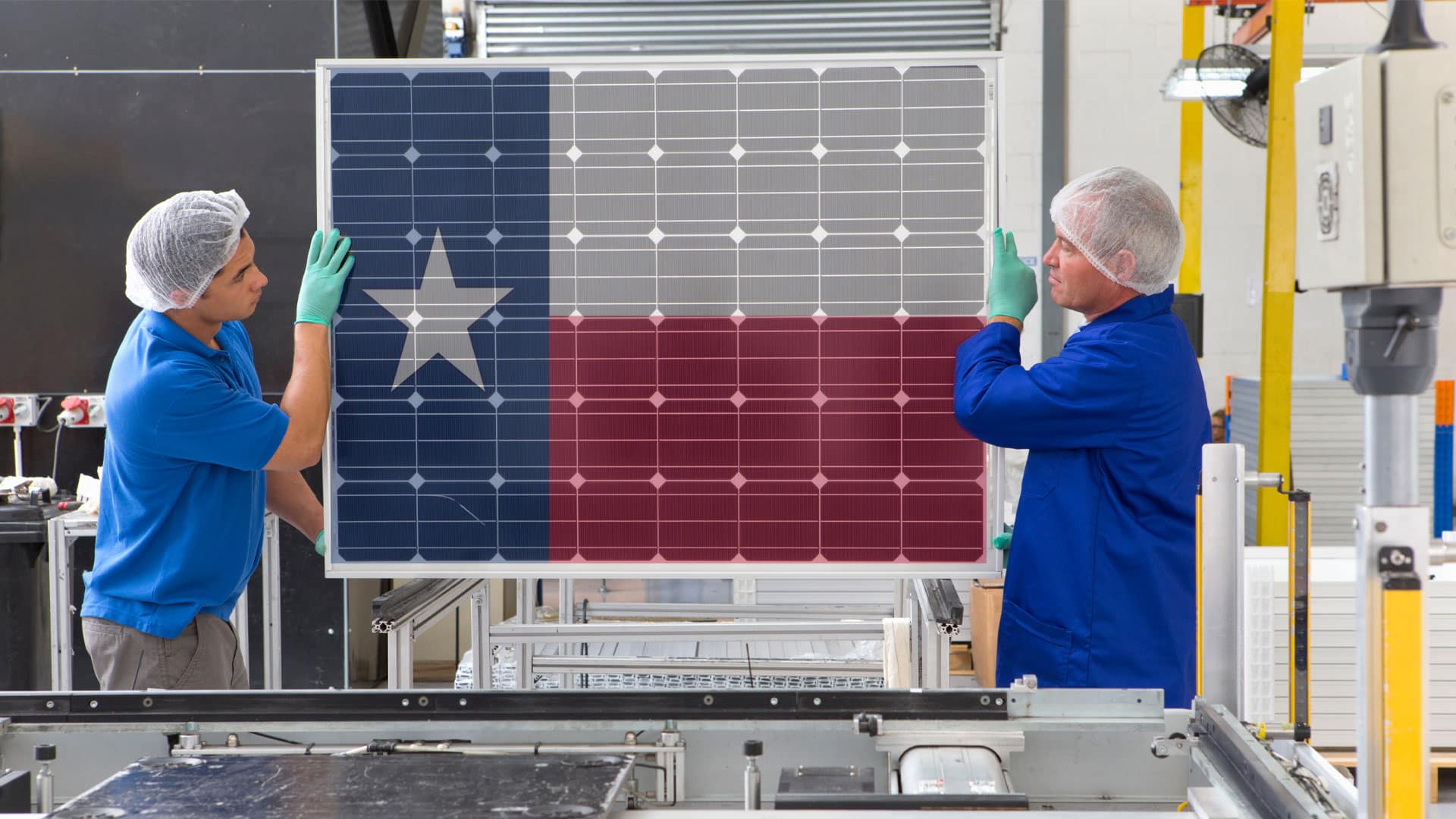
Texas has led the country in installing solar and battery storage for years. In 2026 it also became one of the main places where that equipment gets made. Here’s a roundup of what was announced and opened this year, what “made in Texas” really means right now, and why it matters if you’re planning a commercial or residential project.
Texas Now Makes About Half of America’s Silicon Solar Panels
Texas is projected to pass 15 GW of solar module production in 2026, roughly half of all silicon-based panels made in the United States. Most of that capacity is in the Houston area, with more in DFW, Central Texas, and the Brazos Valley.
A few years ago, industry press called Texas the “new Solar Valley” and wondered whether it would last. It has. In 2026, the build-out moved past panel assembly into solar cells, racking, and battery storage.
The 2026 Roundup: Who’s Building What in Texas
| Company | Location | What They Make | Status |
|---|---|---|---|
| SEG Solar | Houston / Tomball | HJT solar modules; HJT cells planned | 4 GW plant opened Aug. 2026; third plant targeting May 2027 |
| T1 Energy | Wilmer (DFW) / Rockdale | TOPCon modules + cells | 5 GW module plant operating; cell fab targeting Q1 2027 |
| TOYO | Humble | Solar modules; HJT cells planned | 2 GW expansion completed Oct. 2026 |
| Tesla | Fort Bend County (proposed) | Full silicon-to-module campus | Proposed; operations targeted 2029 |
| US Modules | College Station | Utility-scale modules | First line opened March 2026 |
| Mission Solar | San Antonio | Solar modules | Assembling panels since 2014 |
| Tesla Megapack | Brookshire | Utility-scale battery storage | Megapack 3 production began Aug. 2026 |
| Base Power | Austin | Residential battery systems | In production |
| SnapNrack | El Paso | Solar racking and mounting | Opened Nov. 2026 |
SEG Solar: Houston’s Fastest-Growing Panel Maker
SEG Solar has been the busiest manufacturer in the state this year. On August 7, 2026, it opened a 4 GW module plant in Tomball that makes high-efficiency heterojunction (HJT) panels. That brought its total U.S. capacity to 6 GW a year.
A third Houston-area plant, rated at 4.6 GW, is under construction and expected to start production in May 2027. That would take SEG to 10.6 GW of annual U.S. module capacity. In October, SEG also secured land for a planned $950 million HJT solar cell plant on its Tomball campus, a big step toward making the cells here too.
T1 Energy: Solar Cells Made in Central Texas
Cells are the hard part. Most U.S. panel plants, including most in Texas, assemble modules from imported cells. Austin-based T1 Energy is working to change that.
T1 already runs a 5 GW module plant in Wilmer, just south of Dallas. In December 2025 it began building G2_Austin, a 2.1 GW TOPCon cell fab in Rockdale, about an hour northeast of Austin. First cell production is targeted for Q1 2027. T1 expects to offer modules with more than 60% domestic content as the fab ramps up.
TOYO: Expanding in Humble
Japan-based TOYO finished expanding its Humble module factory to 2 GW of annual capacity and held a ribbon-cutting in October 2026. Next is a planned $357 million, 1.5 GW HJT cell line at the same site, targeted for Q1 2028.
US Modules and Mission Solar
In College Station, US Modules opened its first 400 MW production line in March 2026. The facility has room to grow to about 1.4 GW, and its panels go into utility-scale projects developed by its parent company.
In San Antonio, Mission Solar Energy has been assembling panels since 2014, which makes it one of the longest-running module makers in the country.
Tesla’s “Project Crystal Sun”: Big Number, Long Timeline
The biggest headline of the year is still only a proposal. Tesla has filed plans for a $10.1 billion solar manufacturing campus in Fort Bend County. It would handle everything from wafers to cells to finished modules, with commercial operations targeted for early 2029. In September, the Lamar CISD school board unanimously approved a property tax limitation for the project.
It’s reasonable to be cautious here. Tesla has announced large U.S. solar manufacturing plans before that didn’t happen. Treat this one as a strong signal of interest, not a done deal.
Battery Storage: Texas Builds the Batteries, Too
This isn’t only about panels.
That matters because Texas is also where the batteries are going. The U.S. Energy Information Administration expects Texas to account for more than half of the utility-scale battery storage added nationwide in 2026.
The Rest of the System: Racking and Trackers
A solar array is more than its panels. SnapNrack opened a new facility in El Paso in November, moving its assembly and distribution operations from Juarez, Mexico, to the U.S. In Houston, PV Hardware is expanding its solar tracker factory to meet demand.
What “Made in Texas” Actually Means Right Now
This distinction matters, so here it is plainly: today, most panels “made in Texas” are assembled in Texas. The cells inside them are usually still imported, often from Southeast Asia or elsewhere. Large-scale cell production in Texas starts in 2027 at the earliest, and several of the bigger projects are scheduled for 2028 and 2029.
That’s still real progress. Local assembly brings jobs, shorter lead times, and tighter quality control. But if a project needs high domestic content for tax purposes, check the paperwork. “Made in Texas” on a spec sheet and “qualifies for a domestic content bonus” are not the same thing.
Why This Is Happening Now: Federal Trade Policy
Much of the momentum comes from Washington. On August 6, 2026, the White House announced new Section 232 trade measures on polysilicon and the products made from it, including wafers, cells, and modules. Starting December 4, 2026, covered imports face a 15% tariff plus minimum import prices, including $0.22/W for solar cells and $0.38/W for solar modules.
In practice, imported equipment may get more expensive, and domestic supply chains may become more competitive. Federal “foreign entity of concern” (FEOC) sourcing rules are also pushing manufacturers and buyers toward supply chains that don’t depend on China. For background, see our earlier post on how tariffs affect solar and battery storage.
What This Means for Your Project
The NATiVE Perspective
We’ve been designing and building solar in Texas since 2007, long enough to see several supply-chain cycles, tariff fights, and “next big factory” announcements that didn’t pan out. So we’re glad about this year’s growth, and we’re also measured about it. Some of these plants are running today. Others are a year or more away, and a few may never be built.
For our commercial solar clients, we treat equipment selection as an engineering and risk decision, not a marketing one. We look at manufacturer track record, warranty strength, domestic content documentation, and long-term serviceability, along with price and efficiency. As a member of the Amicus Solar Cooperative, we also see broader supply and pricing trends, which helps us advise clients as the market shifts.
Frequently Asked Questions
Planning a Project?
If you’re weighing equipment choices, domestic content, or timing around the new trade rules, we’re happy to walk through it with you, with no pressure.











Leave A Comment