


Solar and Energy News Roundup from Around Texas: October 2026
By Adam Glick, Solar Sherpa, NATiVE Solar
This month’s Texas solar news had a clear theme: batteries kept going up, data centers stayed at the center of Texas energy politics, and delivery charges kept climbing on Texans’ bills. Here’s what caught our attention over the past few weeks, and why it matters if you own a home or run a facility in Texas. Take a gander and follow the links is any of this hits home, dear reader. Thanks for trusting NATiVE to bring you the solar news stuff that matters!
Grid-Scale Batteries (aka “BESS”) Keep Scaling Up Capacity
Linea Energy finances a 500 MWh battery in Upton County
Linea Energy closed debt financing and a preferred equity commitment for Mesa View, a 250 MW / 500 MWh standalone battery in Upton County. It’s scheduled to begin operating in 2027. Upton County sits in West Texas, where fast growth in solar and wind is pushing up demand for multi-hour storage. (ESS News)
Nightpeak doubles its Brazoria County battery site to 300 MW
Nightpeak Energy’s Bocanova 2, a 150 MW / 300 MWh project near Alvin, began operating September 17, and the company announced it October 13. The Bocanova site now totals 300 MW on the ERCOT grid, using Tesla Megapack units. Nightpeak pointed to the speed of large new loads coming onto the grid as the reason it’s building. (Energy-Storage.News)
A battery built for AI’s power spikes
Also in Brazoria County, Greenflash’s Project Soho (400 MW / 800 MWh) has been running since July. It’s billed as the first utility-scale battery designed specifically to absorb the sudden power swings that large GPU clusters create. For context on how much batteries now matter: on July 22, ERCOT set an all-time demand record of 91,308 MW, and Texas batteries set their own discharge record of 11,980 MW the same day. (Tech Times)
More than a third of new home solar now includes a battery
Lawrence Berkeley National Laboratory found that 37% of new U.S. residential solar systems in 2025 included battery storage, up from 25% in 2024. Texas and Arizona saw particularly large increases. The typical home battery size held steady at about 13.5 kWh. (Free Press)
Texas Solar News: New Projects, Big and (Maybe) Bigger
Mitsui’s first U.S. utility-scale solar project goes live near Hillsboro
Black & Veatch finished the 150 MWdc Three W Solar project for Mitsui & Co. on about 875 acres near Hillsboro, roughly 60 miles from the DFW Metroplex. It has ERCOT approval to connect and is sized to power up to 45,000 Texas homes. (Solar Builder)
Fort Bend County weighs incentives for Tesla’s $10.1B solar factory
Fort Bend County commissioners took up four agreements on October 22 for “Project Crystal Sun,” Tesla’s proposed solar cell and module plant on 3,000+ acres southwest of Houston. The agreements include a property tax abatement and an economic development deal. The plant could bring nearly 10,000 permanent jobs, but Tesla still hasn’t committed to a final site. Separately, a federal patent lawsuit in East Texas points to roughly 10 GW of ingot and wafer equipment headed for a Texas production line, which pv magazine ties to the project. (KPRC) [UPDATE BEFORE PUBLISHING: add the result of the Oct. 22 vote]
The Data Center Debate Gets Louder
Abbott extends the data center pause to environmental permits
On September 21, Gov. Abbott directed the Texas Commission on Environmental Quality (TCEQ) to stop issuing permits for data center projects until ERCOT finishes its statewide audit, which it expects to complete in December. That stretches the pause beyond grid connections to air, water and stormwater permits. Abbott also said he’ll work with the Legislature to eliminate financial incentives for data centers next session. (DLA Piper)
Watchdogs say permits kept moving anyway
Public Citizen and the FracTracker Alliance reviewed TCEQ’s public records and found more than a dozen data center permits that advanced after the pause. The governor’s office and TCEQ both say no permits were approved. Part of the gap is a general construction stormwater permit that projects can join simply by filing a notice of intent, which can be enough to start site work. (404 Media)
Tough talk, light penalties
The Texas Tribune found that the water-reporting law state leaders are invoking carries a maximum fine of $500. Of the 334 data center facilities the state tracked from 2020 through 2025, 233 never submitted a required water-use survey. (Texas Tribune)
How data centers get their power could undo air quality gains
A Houston Advanced Research Center report found that statewide nitrogen oxide emissions could rise 35% by 2031 even if data centers stick to grid power plus wind and solar. If they rely on on-site natural gas instead, the increase could approach 400%. At least 288 data center projects are planned across Texas. (Texas Tribune via KSAT)
Your Changing (increasing!) Utility Bill -and the Moves Behind It
Why your CenterPoint delivery charge keeps changing
CenterPoint raised its delivery charge again, to 6.53 cents per kWh, and Texas-New Mexico Power went from 7.4 to 7.7 cents in September. The reason traces back to 2023, when the Legislature let delivery utilities seek rate adjustments more often. That means more frequent changes and less time for cities and consumer groups to review each one. (KPRC)
What some of that money is buying in Houston
CenterPoint’s latest resiliency update reports progress since the program launched in 2024. The utility projects the work will prevent 150 million customer outage minutes in 2026. So far it has:
- installed 83,500+ storm-resilient poles
- cleared 14,000+ miles of higher-risk vegetation
- added 850+ self-healing automation devices
- moved 900+ miles of power lines underground
CPS Energy holds off on a rate increase until 2027
San Antonio’s CPS Energy dropped its rate increase request, citing financial pressure on customers, and says it will revisit the need for an increase in mid-2027. Its last increase, 4.25%, took effect in February 2024. The rate deferral is on the agenda for today’s 1 p.m. CPS Energy board meeting, alongside a review of the August 28 storm response. (Texas Public Radio)
The NATiVE Take on This Month’s Texas Solar News
Two noteable threads are kinda running through this month’s news. First, storage is now standard grid infrastructure in Texas. Utility-scale batteries are being financed and energized on regular timelines, and more homeowners are pairing batteries with new solar. This is fantastic for Texans who like having reliable power. Duh.
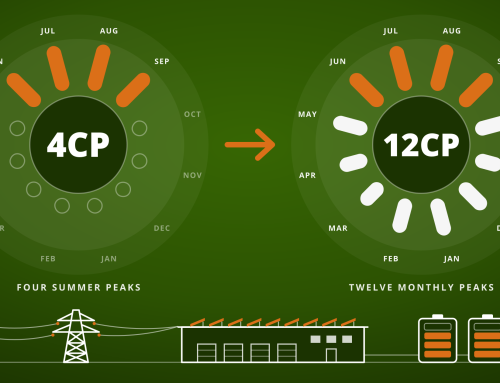
Second for commercial electricity subscribers, the delivery side of your bill keeps moving. Utilities can now adjust delivery charges more often, and data center growth is putting pressure on the whole system, so the costs of building out the grid show up on bills more quickly. For Texas facilities, that’s on top of ERCOT’s shift in how transmission costs are assigned, which we covered in ERCOT 12CP: What the End of 4CP Means for Texas Facilities.
On-site solar and battery energy storage won’t control any of those forces. A well-designed system may reduce a facility’s exposure to them, and how much depends on the load profile, the utility and the tariff. That’s the analysis we start with on every commercial solar project, before anyone talks equipment.
If you’re trying to make sense of what these changes mean for your building or your home, talk with one of our solar consultants. We’ve been working the Texas grid since 2007.
-And thanks for reading, Ya’ll












Leave A Comment