

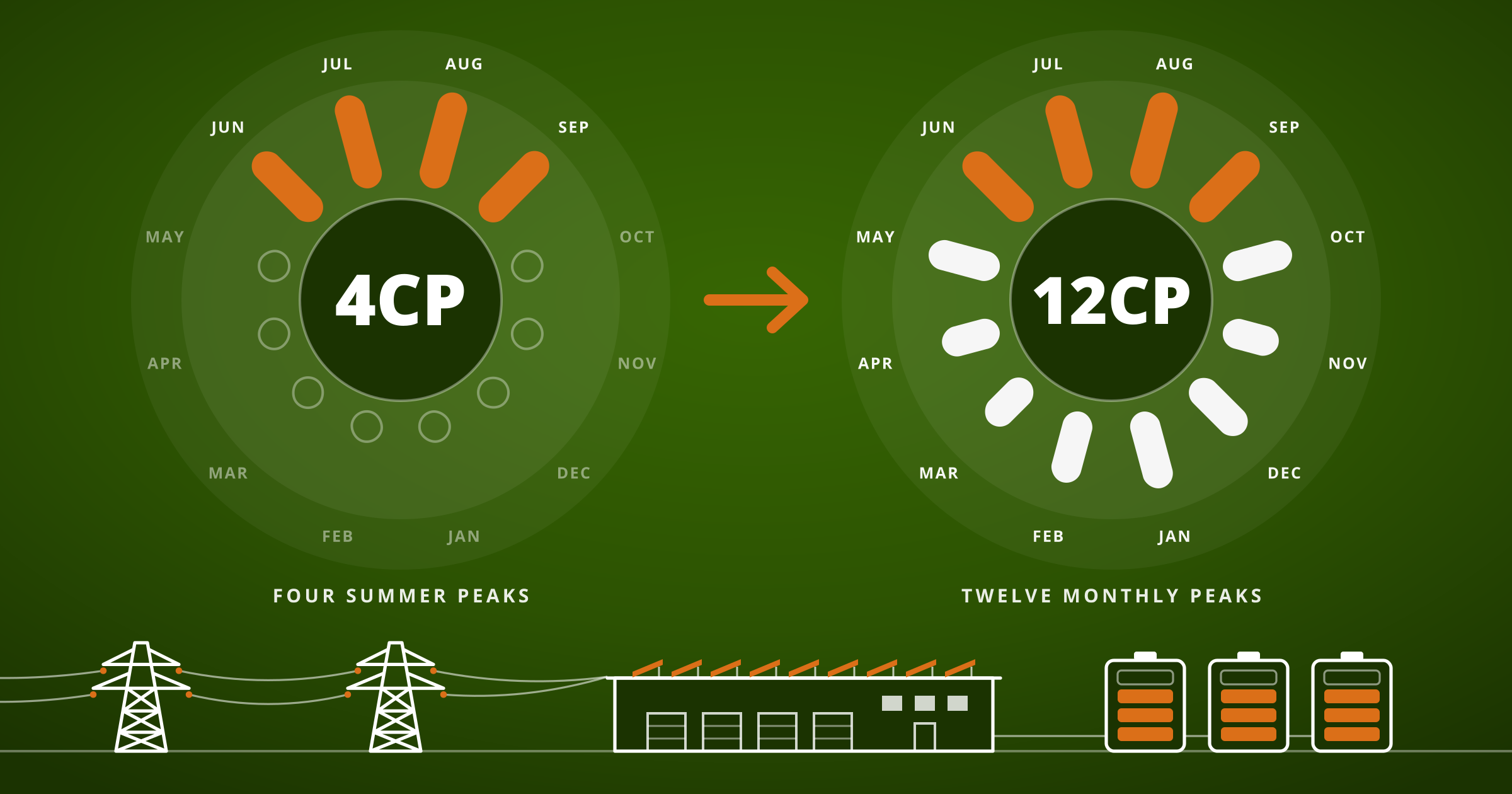
 ERCOT 12CP: What the End of 4CP Means for Texas Facilities’ Electrical Demand Charge Assessment
By Adam Glick, Solar Sherpa, NATiVE Solar
For more than twenty years, large commercial power users in Texas have cut a big piece of their electric bill by using less power on four specific summer afternoons -by which the utility bills’ “demand charge” is set for each customer. State regulators now plan to replace that system, known as 4CP, with ERCOT 12CP, which counts a peak in every month of the year. Here is what is proposed, who it affects, and where solar + battery energy storage fits.
One note before we start: as of early October 2026, this is a proposed rule. The Public Utility Commission of Texas (PUC) expects a final decision in December.
*Heads up: This article is a bit longer and more in-depth than most here at The Feed. Here’s the short version before we get started:
- What is changing: Texas plans to divide the cost of upgrading and maintaining our state’s transmission grid using calculations based on twelve monthly grid peak measurements instead of four summer ones.
- Who it applies to: Every utility in ERCOT. The rule changes how the statewide grid bill is split among them. How that cost reaches your bill depends on your utility and your size.
- Affected most directly: Facilities over 700 kW in the Oncor, CenterPoint, AEP Texas and TNMP areas. They are billed today on their own usage at the grid’s four summer peaks, so twelve peak measurements would change how their charge is calculated.
- Smaller businesses in those areas: You are billed on your own monthly peak, and that method is not changing. This said, your rate could shift as costs are re-divided among customer groups.
- In Austin, San Antonio or a co-op area: Your utility’s share of the grid bill would be set by twelve peaks instead of four. The city or co-op board decides how to pass that on to you.
- When: A final decision is expected in December 2026. Nothing is final yet.
- What to do now: Perhaps find out how your utility bills you for transmission, and look at your power use in every month, not just summer. Also, maybe be open to new ways your site might be able to reduce grid power draw during those times. (hint: adding solar and BESS (battery energy storage) could be one way. :) )
What 4CP is, in plain English
Everyone in Texas helps pay for the high-voltage transmission grid. For large users in much of the state, the share is set by a method called “four coincident peak,” or 4CP.
First, one definition. Demand is how much power you draw at one moment, measured in kilowatts (kW). Energy is how much you use over time, measured in kilowatt-hours (kWh). Think of demand as your speed and energy as the miles you drive. 4CP is about demand.
Here is how it works. In each of June, July, August and September, the ERCOT (Electric Reliability Council of Texas) grid hits one highest 15-minute moment. “Coincident” means at the same moment. What counts is how much power your facility was drawing at the grid’s peak, not at your own.
The average of those four readings sets your transmission charge for the entire next year, as Oncor’s delivery-charge guide explains. So if you use less power during those four 15-minute windows, you pay less (by way of lower “demand charges” on your utility bill) for the next twelve months.
Who is on 4CP billing? In the competitive areas served by Oncor, CenterPoint, AEP Texas and TNMP, meters with peak demand over 700 kW are billed on 4CP. Smaller commercial accounts are billed on their own monthly peak instead. Austin Energy works differently, and we cover it in its own section below.
What it is worth. Each kilowatt you are drawing during those four peaks costs about $68.55 over the following year. That rate is up 121% since 2013. A facility that cuts 1,000 kW (one megawatt) during the peaks avoids about $68,550 a year at the full rate, or about $40,740 at Oncor’s rate, according to a joint filing by Base Power, Octopus Energy and Tesla.
Bottom line: under 4CP, four short windows each summer set a full year of transmission charges.
Why regulators are moving on from 4CP
Three things are pushing the change to ERCOT 12CP.
The law requires it. Senate Bill 6, passed in 2025, tells the PUC to revisit how transmission costs are divided and to change its rules by December 31, 2026 (K&L Gates summary).
The grid’s stress points have moved. 4CP only looks at summer afternoons. According to the same summary, PUC staff found the grid now runs tightest on summer evenings, after solar output drops, and that 4CP ignores winter shortages entirely. Staff also found 15 minutes too short a window. ERCOT’s independent market watchdog has recommended dropping 4CP since 2015, according to an ERCOT board presentation from September.
Households are paying more than their share. In 2024, homes used 34.5% of the electricity but paid 46.7% of transmission charges, according to PUC staff figures cited in the retail-provider filing. The reason is simple. When a large user cuts back during the four peaks, its share of the bill does not disappear. It moves to everyone else. As PUC Chairman Thomas Gleeson put it on the Energy Capital Podcast in June, “those transmission costs have to be paid by someone.”
The bill itself is also growing. ERCOT endorsed about $14.0 billion of transmission projects in 2025, compared with $3.8 billion in 2024.
What the ERCOT 12CP proposal would change
On July 9 the PUC voted to publish a proposed rule, Project 58000. It appeared in the Texas Register on July 24. The core change replaces 4CP with ERCOT 12CP:
| 4CP today | 12CP as proposed | |
|---|---|---|
| Peaks counted | Four, June through September | Twelve, one per calendar month |
| Length of each peak window | 15 minutes | 30 minutes |
| Measurement year | Summer only | October 1 through September 30 |
| How costs are split among customer groups | Revisited only when a utility files a rate case | Updated every year |
The proposal also sets a minimum charge, lasting at least 20 years, for “large loads.” ERCOT defines a large load as 75 megawatts or more at a single connection point. That piece is aimed at data centers, not at a typical plant, hospital or distribution center. This seems like a fine idea to us here at NATiVE. :)
None of the ERCOT 12CP proposal is final. Public comments closed August 11. In a July 17 letter to Gov. Abbott, Chairman Gleeson wrote: “The PUCT expects to make a final decision on the rulemaking in December 2026.” He has also said the commission may count some months more heavily than others, or group the peaks in summer and winter. The details could still change.
Who ERCOT 12CP applies to
The rule applies to every utility in ERCOT, but it does not reach every customer the same way. Think of a restaurant bill split among several tables. The rule changes how the bill is split among the tables. How each table divides its share among the people sitting at it is a separate question.
First, the grid bill is split among utilities. This part applies to everyone. Oncor, CenterPoint, Austin Energy, CPS Energy and the electric co-ops would all have their share set by twelve monthly peaks instead of four summer ones.
Then each utility bills its own customers. This is where it differs. The PUC sets customer rates for the investor-owned utilities, such as Oncor, CenterPoint, AEP Texas and TNMP. City-owned utilities and co-ops set their own.
| Who you are | How you are billed for transmission today | What 12CP would change |
|---|---|---|
| Large facility (over 700 kW) in the Oncor, CenterPoint, AEP Texas or TNMP areas | On your own usage at the grid’s four summer peaks | The calculation itself. Twelve peaks would flow through to your bill. |
| Smaller business in those same areas | On your own monthly peak | Not the method. Your rate could shift as costs are re-divided among customer groups. |
| Any business served by Austin Energy, CPS Energy or a co-op | However that utility chooses. In Austin, on your own monthly peak. | Your utility’s total share. The city or co-op board, not the PUC, decides how to pass that on. |
Bottom line: everyone is affected, but large facilities in the investor-owned utility areas are affected most directly.
What ERCOT 12CP could mean for your facility/site:
The biggest unknown is your own bill. The proposal explains how the cost is divided among utilities and among customer groups. It does not yet say how each utility will calculate an individual large customer’s charge. That answer comes after the final rule, when each utility files its new rates. (We’ll try to cover this in a timely manner with updates published here at The Feed.)
Twelve peaks to manage instead of four, and each counts for less. Today, each summer peak sets about a quarter of a large facility’s transmission charge. With twelve equally weighted peaks, each would set about one-twelfth. The retail-provider filing estimates that power used during a 12CP peak would effectively carry more than $5,000 per megawatt-hour in transmission line cost.
Sites that cut back in summer have more to cover. A facility that has reliably reduced its power use for four summer peaks would now have eight more months to watch. The forecasting firm Amperon notes that the months nobody used to watch have the weakest track record.
The shift between customer groups looks modest. A draft PUC staff analysis shows 12CP lowering the residential share of transmission cost by about 3.1 percentage points, from roughly 46.3% to 43.1%. The retail providers call that “meaningful but still relatively small.”. Yeah, it’s small, but it ain’t nothin’ -plus other parts of the new PUC rules should mean that the additional cost burden of new data centers should also largely be kept away from us “normal” residential and commercial rate-payers that aren’t gobbling up so much energy as those gargantuan facilities.
The total does not shrink. ERCOT 12CP changes how the transmission bill is divided, not how large it is.
What ERCOT 12CP means for Austin Energy customers
Austin Energy customers are not billed on 4CP. Commercial customers at 10 kW and above pay a Regulatory Charge on their own highest 15-minute peak each month. That charge covers Austin Energy’s ERCOT transmission costs and related fees, according to its tariff. In other words, Austin businesses already pay for transmission on twelve peaks a year. They are their own peaks, not the grid’s.
That charge just went up. On October 1, 2026, it rose from $3.73 to $5.03 per kW for secondary-voltage customers, about 35%. Austin Energy’s budget shows transmission and ERCOT expenses rising from $217.7 million to $234.8 million. Add the demand charge, and a secondary customer at 300 kW or more now pays $18.22 for each kW of monthly peak, based on Austin Energy’s posted rates.
Summer still matters in Austin, but not the way 4CP does. Your demand is measured every month, and each bill is based on that month’s own highest 15 minutes. What summer decides is your rate class. Once a year, Austin Energy averages your June through September demand to place you in a class, such as 10 to 300 kW or 300 kW and up, and that class sets your per-kW rates for the next calendar year. Separately, Austin Energy pays businesses $50 to $80 per kW to cut load during summer peak events through its Commercial Demand Response program.
4CP also shapes how Austin Energy values solar. The formula in Austin Energy’s tariff for valuing solar production includes a credit for avoided ERCOT transmission charges. That credit is based on how much solar was producing during the hour of ERCOT’s peak in each of June, July, August and September. In other words, solar earns part of its value in Austin by showing up at the four summer peaks. If Texas moves to twelve peaks, including winter mornings and evenings when solar produces little, that formula may need to change. Austin Energy has not said how it would handle that.
ERCOT 12CP would reach you indirectly. Austin Energy’s own share of the statewide grid bill is set by the city’s load at the four summer peaks. Under 12CP it would be set by twelve. How that changes the Regulatory Charge is a City of Austin decision that has not been announced.
Bottom line: in Austin, your own monthly peak already drives what you pay for transmission. Lowering it, with load management, solar or solar + storage, may reduce both your demand charge and your Regulatory Charge.
When ERCOT 12CP peaks are likely to land
ERCOT 12CP counts one peak per month, so the time of day those peaks tend to fall matters for planning.
Summer peaks are moving later, past solar’s best hours. ERCOT’s highest peak of the year fell at 5:00 p.m. every year from 2008 through 2022. It then fell at 6:30 p.m. in 2023 and 6:00 p.m. in 2024, according to a table in NRG’s filing. This summer’s all-time record of 91,134 MW, set July 22, came between 6 and 7 p.m. (ERCOT summer review).
Winter peaks come early and late. ERCOT says winter risk is highest from 6 to 9 a.m. and 6 to 9 p.m., hours with “the highest loads and low or no solar production” (ERCOT Monthly). Winter peak demand has grown about 30,000 MW in ten years.
Bottom line: many of the twelve peaks are likely to fall when the sun is low or down.
Where solar + storage fits
Solar still does what it has always done. It reduces the amount of grid energy you buy and lowers your demand through the sunny hours, including many summer afternoons. ERCOT’s own review of this summer credits it at grid scale: “Solar growth outpacing large load additions helped make the daytime hours this summer uneventful.”
What solar cannot do alone is cover a January morning at 7 a.m. or a July evening at 7 p.m. That is the job battery energy storage is suited for. Covering a 30-minute window is short work for a properly sized battery. The harder part is knowing which half hour it will be, twelve times a year. That takes good forecasting and controls. Your company’s site energy plan(s) should comprehend this.
There is also a year-round reason to manage demand that has nothing to do with this rule. Under Oncor’s rates, you are billed for the higher of two numbers: this month’s peak, or 80% of your highest peak in the previous 11 months. One bad interval can follow you for a year. In Austin, each month’s charge is based on that month’s own peak.
NATiVE has treated commercial solar as a systems engineering problem since 2007, and our advice is the same under 4CP or ERCOT 12CP. Start with twelve months of your meter data. Find out when your facility peaks compared with the grid. Size the system from there. For some sites, that points to solar + storage now. For others, solar alone does the job and storage waits until the numbers support it. Either way, solar + storage may reduce exposure to demand-based charges. How much depends on your usage pattern, your rate and your utility.
What to do before December, perhaps
- Ask your electricity provider or broker whether your meter is billed on 4CP.
- If you are served by Austin Energy, CPS Energy or a co-op, ask how it plans to pass 12CP costs through to commercial rates.
- Pull twelve months of interval data, your meter’s record of power use in 15-minute steps, from your utility or Smart Meter Texas.
- Ask your provider how transmission charges pass through in your contract, and what happens if the method changes mid-term.
- Look at your demand during each month’s grid peak, not just the summer ones.
- Watch for the PUC’s final ERCOT 12CP rule, expected in December, and the utility rate filings that follow. (We’ll be reporting o that here at The Feed.)
- If you are evaluating solar or storage, ask a competent solar+BESS design-construction firm (blatant NATiVE Solar plug here) to help with the modeling under both methods.
Not sure how your facility is billed for transmission, or what twelve peaks could mean for it? Talk with our commercial team. Bring a recent bill and we will start there.
Frequently asked questions
What is ERCOT 12CP?
ERCOT 12CP stands for twelve coincident peak. Under it, transmission costs would be divided using demand during the grid’s highest 30-minute window in each calendar month, instead of four summer windows.
When does ERCOT 12CP take effect?
No date is set. The PUC expects a final decision in December 2026. The proposal measures peaks from October 1 through September 30, with ERCOT filing the results by December 1 each year.
Does ERCOT 12CP apply to my business?
It applies to every utility in ERCOT, so every business is affected in some way. Facilities over 700 kW in the Oncor, CenterPoint, AEP Texas and TNMP areas are affected most directly, because they are billed on their own usage at the grid’s peaks. Smaller businesses, and customers of city-owned utilities and co-ops, are affected through how costs are shared and passed on.
Will ERCOT 12CP lower my electric bill?
Not by itself. It changes how the transmission bill is divided, not its size. Sites that relied on cutting back in summer may see their share rise unless they manage demand year-round.
Does solar still help with demand charges under 12CP?
Solar helps in daylight hours, including many summer peaks. Winter and evening peaks fall when solar output is low, which is where battery storage and load management come in to play.
Does 12CP apply to Austin Energy or CPS Energy customers?
Not directly. City-owned utilities and co-ops would see 12CP in what they pay for the grid, and they set their own customer rates. Austin Energy already bills commercial customers for transmission on their own monthly peak, through its Regulatory Charge. We’ll be watching from here at our Austin (Dripping Springs) HQ and will publish updates when/if anything changes for commercial sites within AE’s and CPS’s jurisdiction.
Sources and how we checked them
We referenced the proposed PUC rule itself, ERCOT’s own reports, and Austin Energy’s tariff and budget -among other sources. Yes, we used AI a bit to help us sort through all the data and its implications. We did not have direct access to some of the reporting and data on this topic, including a paywalled trade-press account of the July 9 vote, several filings in the PUC’s document system, and the PUC staff’s final report. Where that was the case, we worked around the edges to substantiate the facts through documents we could open: the Texas Register, ERCOT board materials, the PUC’s letter to the Governor, and public filings that quote the staff report’s figures. The staff numbers above come from the draft report, as quoted in those filings, and two of our sources (NRG and the retail-provider coalition) have a stake in the outcome.
- PUC Project 58000, proposal for publication (July 9, 2026)
- Texas Register, July 24, 2026
- PUC Chairman Gleeson, letter to Gov. Abbott (July 17, 2026)
- Energy Capital Podcast with Chairman Gleeson (June 10, 2026)
- K&L Gates, alert on the PUC staff draft report (March 30, 2026)
- NRG Energy, comments in PUC Project 58484 (September 2025)
- Base Power, Octopus Energy and Tesla, joint comments in PUC Project 58484
- ERCOT, staff response to the Independent Market Monitor (September 2026)
- ERCOT, Summer 2026 Operational and Market Review
- ERCOT Monthly, November 2025
- ERCOT, System Planning and Weatherization Update (February 2026)
- Oncor, Delivery Charges 101
- Amperon, 12CP explainer (August 2026)
- City of Austin Electric Tariff, FY 2027 (effective October 1, 2026)
- City of Austin Electric Tariff, FY 2026
- Austin Energy, commercial rates
- Austin Energy, FY 2027 proposed budget (July 20, 2026)
- Austin Energy, Commercial Demand Response program





















Leave A Comment