

 CenterPoint’s Grid Upgrades Are Hitting Houston Bills. Here’s What Businesses Can Actually Control
By Adam Glick, Solar Sherpa, NATiVE Solar

Has your Houston-area electric bill been creeping up? Before you yell at your retail provider, take a look at the delivery line, not just the energy line. CenterPoint Energy is spending billions to harden its system after a rough run of storms, and Texas lets utilities recover approved costs from customers. (Yep. That’s us.) So here’s what’s been approved, roughly what it costs, and where a business actually has some room to respond.
What’s Been Approved?
Three things are pushing Houston delivery charges upward:
- The 2026–2028 resiliency plan. In late 2025, the Public Utility Commission of Texas approved CenterPoint’s roughly $2.9 billion plan. Think more storm-resilient poles, more underground lines, and tree trimming along every line on a three-year cycle instead of five. And that was the trimmed-down version. CenterPoint originally asked for a lot more.
- Storm recovery. Separately, regulators approved recovery of about $1.2 billion in costs, mostly tied to Hurricane Beryl, spread over 15 years.
- Routine infrastructure recovery. CenterPoint adjusts its Distribution Cost Recovery Factor (DCRF) twice a year to recover ongoing spending on poles, wires and substations.
Yikes. Well, we knew it was coming. However, one thing actually went the other way: a settled rate case cut CenterPoint’s annual revenue by about $50 million. That takes roughly $1 a month off most customers’ bills from 2025 through 2029. Small win, but we’ll take it.
The Resiliency Plan: What CenterPoint Asked For vs. What It Got
CenterPoint cost items (billions of dollars)
Sources: Energy Capital HTX, KPRC, Houston Chronicle. Figures rounded.
What Does It Cost? (For Households, Anyway)
| Item | Published residential impact |
|---|---|
| Resiliency plan | ~$1/month starting 2026, rising to ~$4/month by 2028 |
| Storm recovery (Beryl and others) | ~$2/month for the average household, over 15 years |
| Settled rate case | ~$1/month reduction for most customers, 2025–2029 |
[REVIEW: financial claim] For businesses, there’s no single number. The impact depends on your rate class, demand and usage. Your REP can show you the current CenterPoint delivery components on your bill, and the PUC tariff filings have the gory details.
Why It Matters More Than It Looks
A few bucks a month is noise for a household. For a facility with heavy usage, though, delivery charges are a real slice of the bill. And they’re the slice you can’t shop. You can switch REPs and renegotiate your energy rate all day long. You can’t switch wires companies.
That’s where on-site energy comes in. Let’s be real: it won’t make CenterPoint’s charges go away. Here’s what it can do:
- Solar may reduce the kWh you pull from the grid, which can trim delivery charges billed per kWh. [REVIEW: financial claim]
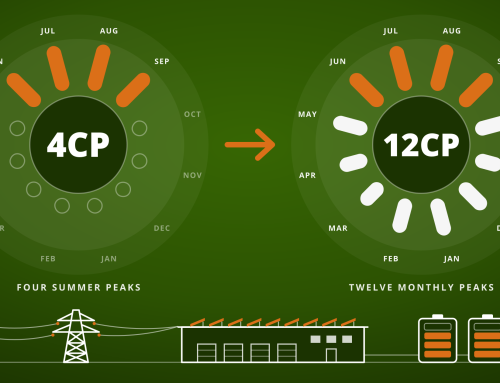
- Battery energy storage can support demand charge mitigation, which matters more as ERCOT moves transmission cost allocation from 4CP to 12CP. See ERCOT 12CP: What the End of 4CP Means for Texas Facilities.
- Solar + storage designed for resilience can keep critical loads running during an outage.
That last one comes with a big asterisk: a standard grid-tied commercial solar system turns off when the grid goes down. Backup capability has to be designed in from the start. You can’t bolt it on as an afterthought and expect it to work when the next storm rolls in.

[IMAGE PLACEHOLDER: a Houston-area NATiVE solar or solar + storage project, if you have one cleared for use. Replace the image above and delete this line.]
To Be Fair to CenterPoint…
Houston has taken a beating, and often: Uri, the 2024 derecho, Beryl. Customers wanted fewer and shorter outages, and the resiliency plan is aimed squarely at that. CenterPoint calls it part of a commitment to building “the most resilient coastal grid in the country.” Will it deliver? Houstonians will be the judge over the next few storm seasons. Either way, the costs are approved and they’re on the bill.
Where Do We Fit In?
Lately our conversations with Houston facility managers are less about “going solar” and more about how much of their energy cost they can actually influence. [REVIEW: confirm, or swap in a real Houston example] Sometimes the answer is solar. Sometimes it’s storage. And sometimes it’s neither, and we’ll tell you that straight.
Want a second set of eyes on a Houston-area facility’s bills? Let’s talk. Or read more about our commercial battery energy storage work.


















Leave A Comment