

 Meter Collars for Solar in Texas: Why the Rules Depend on Who Delivers Your Power
By Adam Glick, Solar Sherpa, NATiVE Solar
If you’ve researched solar or battery storage recently, you may have come across “meter collars” -small adapters with sensors that promise to cut installation costs and skip a panel upgrade. They’re a real shift in how residential solar gets connected. But whether you can actually use one in Texas depends entirely on which utility delivers power to your address. In fact, there are a few details worth understanding before you get too far into project planning. OK, let’s go!
What a meter collar actually does
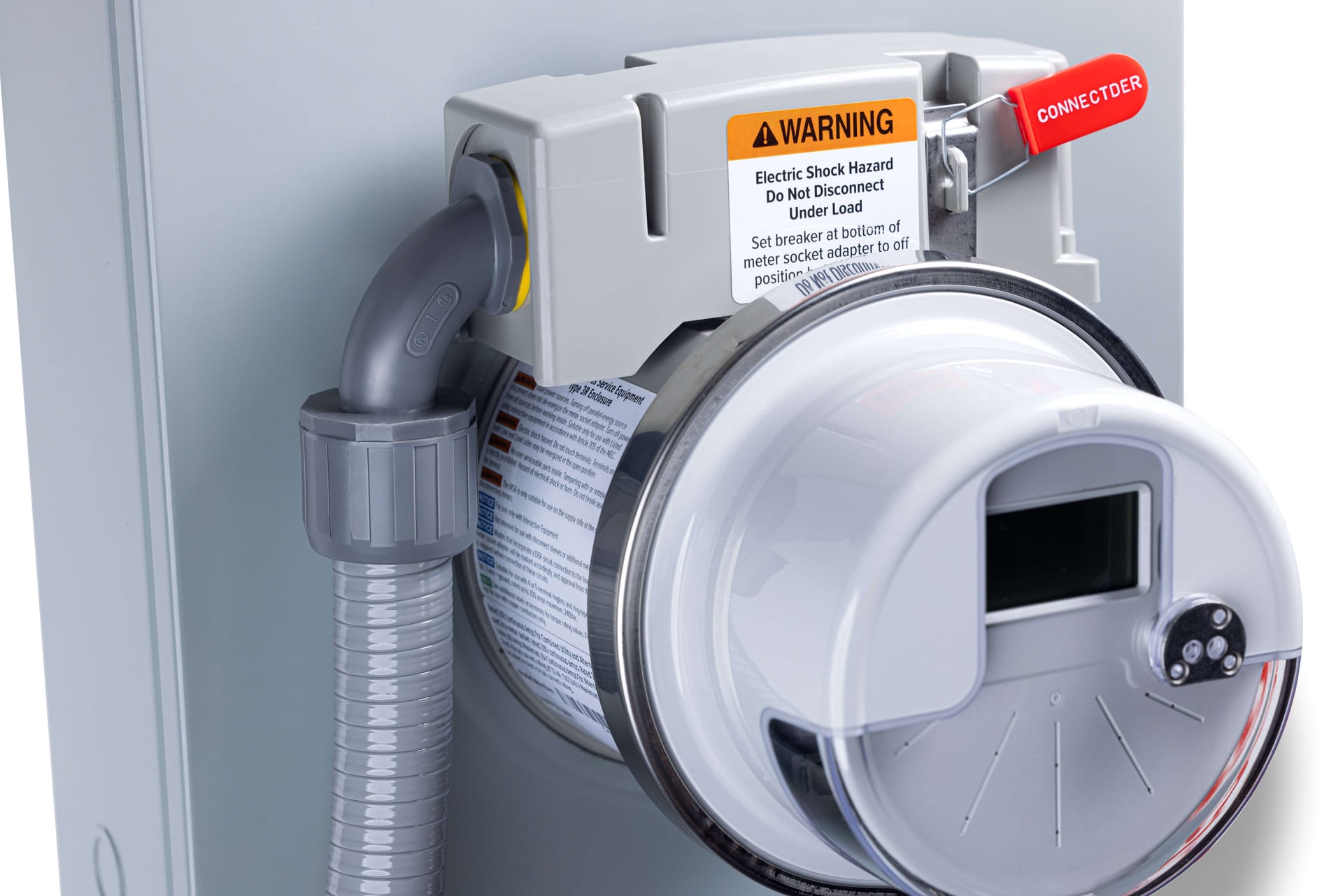
A meter collar (aka “meter socket adapter” or (MSA)) installs between your existing utility meter and the meter socket on the side of your house. Instead of routing new solar, battery, or EV charging circuits through your main electrical panel, the collar provides a dedicated connection point right at the meter.
That matters because many older homes have 100-A or 125-A electrical services that weren’t sized for solar, storage, and EV charging on top of everyday household load. Historically, the fix was a full panel upgrade or a new subpanel -a project that adds real cost and time, and in some cases requires trenching, permitting delays, and utility coordination on top of the solar installation itself. NATiVE Solar has done hundreds of these over the years. Meter collars from manufacturers like ConnectDER, Enphase, and Tesla are designed to reduce or avoid that step by tapping in to the utility/grid power ahead of the main panel.
Newer meter collars also do more than provide a connection point. Because they sit at the point where utility power meets the home, they can read power flow for inverter control, support third-party ownership arrangements, and – if paired with the right hardware- act as a disconnect that automatically isolates the home from the grid during an outage so a battery system can power the house.
Some of the newest hardware assumes you’ll have one
This isn’t just a cost-saving option anymore -some current battery hardware is built around it. Enphase’s 4th-generation Energy System, built around the IQ Battery 10C, System Controller 3M and IQ Combiner 6C, uses the IQ Meter Collar as the microgrid interconnect device (MID) that automatically and instantaneously isolates the whole home from the grid during an outage. For whole-home backup on a meter-main combination panel -the standard setup in many newer Texas homes, where the meter sits directly on the front of the main panel -Enphase’s own documentation treats the meter collar as essential to that configuration, since there’s no straightforward way to add a separate disconnect ahead of the panel otherwise.
In other words, the choice of battery hardware and backup configuration can quietly decide whether a meter collar is required, not just preferred. That’s a design decision that needs to be discussed before a system is proposed, not after a utility kicks back the interconnection application.
The catch: not every Texas utility allows them
This is a new technology which electric utilities are only now starting to catch up to. Meter collars require modifying the space around utility-owned metering equipment, which means each utility has to approve their use before an installer can put one in. That approval process isn’t uniform across Texas, and the differences are significant enough to shape how a project gets designed. Don’t worry, NATiVE’s in-house permitting department has you covered here.
Oncor, which delivers power across much of North and West Texas including the Dallas–Fort Worth area, explicitly does not allow meter collars. Oncor’s Electrical Service Guidelines reserve the space inside the meter socket for utility use only and instead require a Visible Lockable Labeled AC Disconnect (VLLD) (a separate, accessible disconnect switch mounted within 10 feet of the meter) for every newly connected solar+battery distributed generation system. If a project is designed around a meter collar for an Oncor-served property, it will need to be redesigned around a VLLD instead.
CenterPoint Energy, serving the Houston area, similarly centers its interconnection requirements around a lockable, external-handle disconnect switch near the meter rather than a meter collar program.
Austin Energy, by contrast, references meter collar (aka “meter socket adapter”) configurations in its interconnection guidance, though projects still go through its standard PV meter grouping requirements and a variance process if equipment can’t be grouped as specified.
For other Texas utilities, including municipal and cooperative providers, policy varies and is worth confirming directly before a system is designed around collar-based equipment. Enphase’s own utility approval list, for example, currently includes Austin Energy along with several Texas electric cooperatives — but not Oncor or CenterPoint. NATiVE Solar has confirmed directly that other utilities including Bandera Electric Co-Op, Bluebonnet Electric Co-Op, Farmers Electric Co-op, and CoSersv are all supporting meter collars for new solar+battery installations.
What to do when the suggested system design needs a collar the utility won’t allow
WHat if you want the latest solar+battery components but your utility doesn’t allow for it? Well, you’ve still got options, folks: when a project’s battery configuration calls for a meter collar and the local utility doesn’t permit one, there are generally two paths forward, and which one applies depends on the utility.
Request a variance or alternate approval where the utility offers one. Some Texas utilities have a documented process for approving equipment that doesn’t fit their standard configuration. Austin Energy, for instance, has a formal meter variance process for equipment that can’t be grouped or located per its standard criteria, along with a meter collar consent form in its interconnection portal — meaning a project can be reviewed and approved on a case-by-case basis rather than rejected outright. Not every utility offers an equivalent path, and Oncor’s guidelines currently read as a flat prohibition with no published variance process specific to meter collars, so this route isn’t available everywhere. It’s also worth noting that a statewide standard is under active discussion: the Public Utility Commission of Texas is currently considering rule changes (Project No. 54233) that would establish a formal meter socket adapter approval process, with Tesla, Enphase, the Texas Solar + Storage Association, the Solar Energy Industries Association, and the Texas Advanced Energy Business Alliance all weighing in. That could eventually standardize approvals across utilities, but it isn’t in effect yet.
Install the collar as a standalone unit instead of behind the meter. Meter collar manufacturers, including Enphase, also support a standalone configuration where the collar sits in its own dedicated meter socket pan next to the utility’s meter rather than being installed behind it. Because a standalone unit doesn’t touch utility-owned equipment, it typically doesn’t require the utility’s sign-off the way a behind-the-meter installation does. This effectively functions as adding a second, customer-owned meter socket to the property -at the customer’s expense for the extra hardware and electrical labor- as a way to get the functionality of a meter collar even where the serving utility won’t approve one at the existing meter.
Which path makes sense depends on the utility, the battery hardware, and the home’s existing service -which is exactly the kind of question worth resolving during design, not during permitting.
Why this matters before you sign a contract
Here’s the bottom line, folks : The practical takeaway is that a meter collar quoted for a project in one part of Texas may not be usable at all in another, even though the underlying solar and battery equipment is identical. Getting this wrong late in the process can mean re-drawn one-line diagrams, a resubmitted interconnection application, and a delayed permission-to-operate date -all avoidable with the right groundwork up front.
This is really a subset of a broader landscape here in Texas : solar interconnection rules are set utility by utility, not statewide, and they change. ERCOT governs the grid itself, but Oncor, CenterPoint, Austin Energy, CPS Energy, AEP Texas, and dozens of municipal and cooperative utilities each maintain their own interconnection standards, disconnect requirements, and equipment approvals. A design that clears one utility’s review can bounce back from another’s.
We’ve been navigating these utility-specific requirements across Texas since 2007, which is part of why we treat interconnection as an engineering step, not paperwork to rush through after the equipment is chosen. Knowing in advance whether a given utility allows a meter collar, requires a VLLD, or has its own meter-grouping rules shapes the electrical design, the permit packet, and the project timeline — not just the equipment list.
If you’re planning a residential solar and battery project and want to know what your specific utility will and won’t allow, get in touch and we’ll walk through what applies to your address.

















Leave A Comment