


 Texas Solar News Roundup for May 2026
By Adam Glick, Solar Sherpa, NATiVE Solar
So, this month -May- was a big one for Texas solar. A landmark EIA forecast confirmed what industry watchers have been expecting for two years: solar is going to beat coal in Texas in 2026 for the first time in history. Alongside that headline, a wave of major project announcements and a tightening policy clock are reshaping the near-term landscape for developers, businesses, and property owners across the state.
Here’s what the heck is going on across our state, dear reader.
Solar Beats Coal in Texas in 2026
The U.S. Energy Information Administration published its forecast this month: utility-scale solar generation in the ERCOT grid (Texas’s main grid operator) is expected to reach 78 billion kilowatt-hours (BkWh) in 2026, compared to 60 BkWh for coal. That’s the first time in the history of the Texas grid that solar will outproduce coal on an annual basis!
This news implicates a structural shift driven by years of falling solar costs, increasing corporate and industrial demand for clean energy, and the sheer scale of project construction underway across the state. And this -despite very strong anti-renewable energy hawks in both the Texas legislature and in DC- is validation of solar power’s viability going forward..
The projection: Texas is responsible for approximately 40% of total U.S. solar capacity additions expected in 2026. The state has become the de facto center of gravity for utility-scale solar in North America. This is something that would have been unimaginable ten years ago when Texas still had essentially no utility solar to speak of. So yay us!
For NATiVE’s commercial clients, this milestone is worth paying attention to beyond the symbolism. As solar increasingly sets the marginal price on ERCOT during peak sunlight hours, the dynamics of electricity purchasing, demand charge mitigation, and battery energy storage (BESS) dispatch strategy are shifting. We’ll have more on those market mechanics (energy costs, dwindling supply, and related stuff) in an upcoming post.
$12.8 Billion in Texas Solar Projects Coming Online This Year
The number would have been much higher if not for political and policy headwinds out of D.C., but Industrial Info Resources is tracking 37 utility-scale solar projects valued at $12.8 billion that are set to complete construction in Texas in 2026. To put that in perspective: that’s more than many entire national grids have added in a single year.
The mix of projects spans West Texas, the Panhandle, and Central Texas, with the bulk of capacity concentrated in regions with the strongest solar resource and transmission access. Several include co-located battery (BESS, or battery energy storage systems) -a trend that’s accelerating as the economics of solar-only projects become increasingly dependent on the ability to shift generation into higher-value hours. (We’ve written at-length about battery energy storage here at The Feed)
For Texas businesses considering whether now is the right time to move on a commercial or industrial solar project, this level of capacity addition is relevant context: supply chains are active, installer pipelines are full, and engineering firms and interconnection queues are busy. Projects that begin development in 2026 will benefit from that activity -but lead times are not shrinking. We’re busy these days here at NATiVE.
Tehuacana Creek: The Largest Solar+Storage Project of 2026
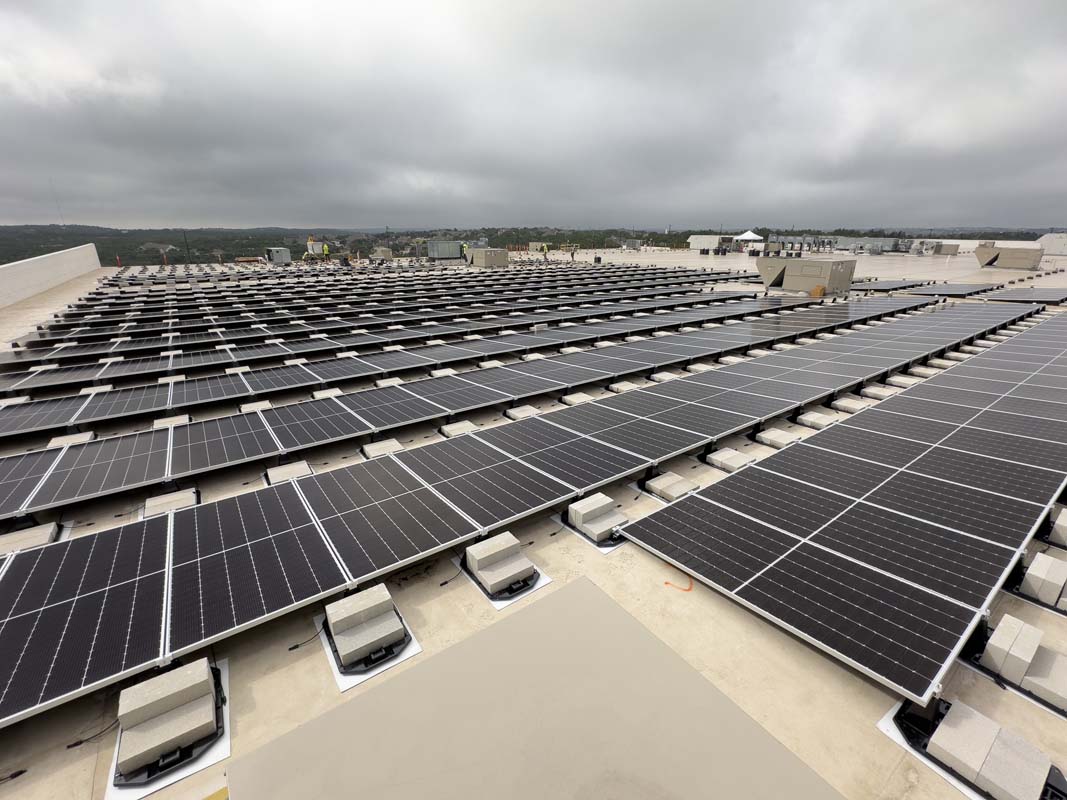
Among the projects scheduled to be coming online this year, Tehuacana Creek 1 Solar and BESS stands out. At 837 megawatts, it’s expected to be the largest utility-scale solar photovoltaic project to complete construction anywhere in the United States in 2026. The project pairs solar PV with battery energy storage, making it a significant data point for large-scale solar+storage integration on the Texas grid.
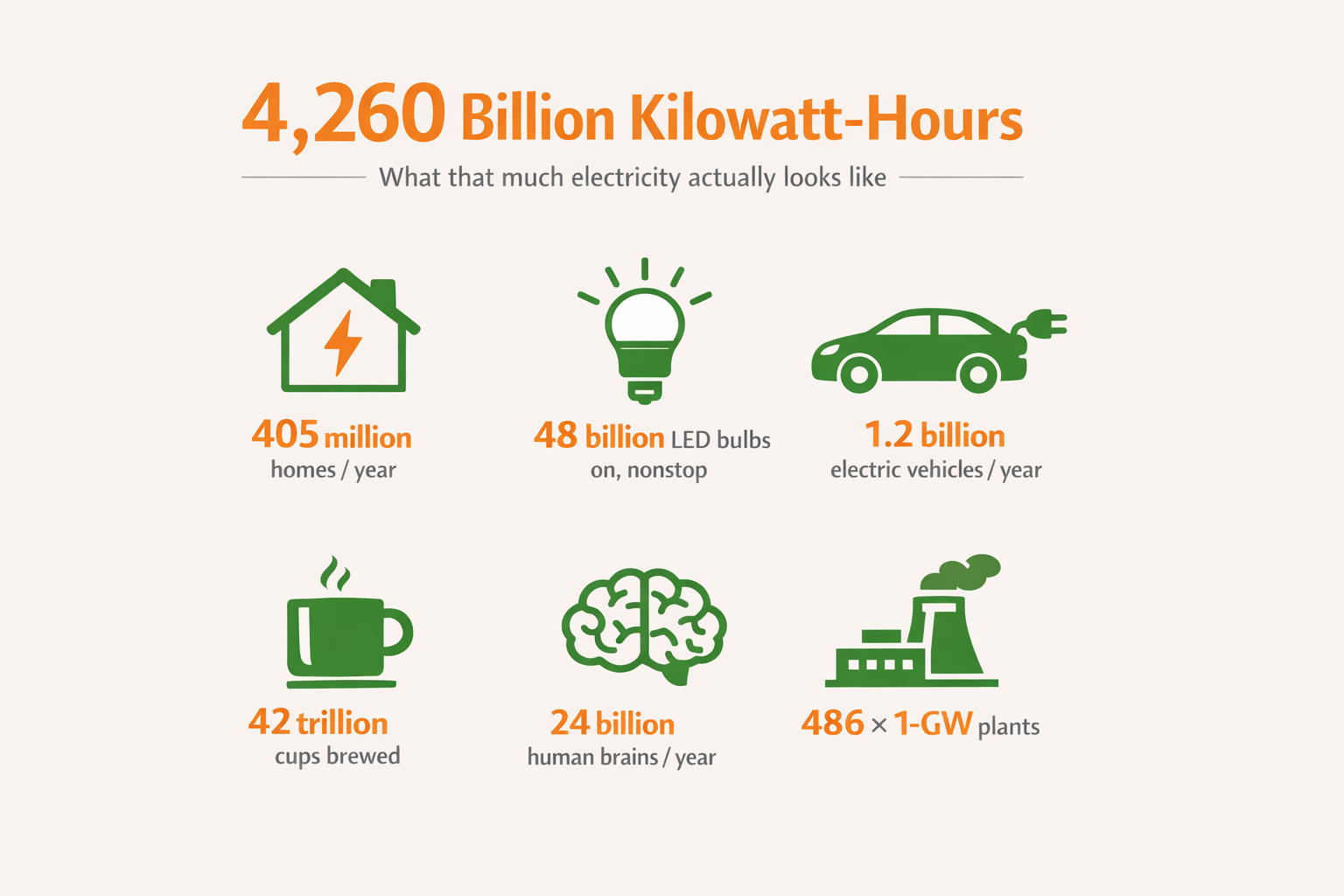
Here’s some relatable numbers about this project which i stole to share here with you folks:
170,000 – Gas cars taken off the road for a year
150 billion – Smartphones charged
28 million – Propane grill tanks
105,000 – Homes powered for a year
600 million – Gallons of water saved per year (enough to supply a mid-sized town for several months)
The grid-scale project points more broadly at the growth of paired solar+storage designs we’re implementing in the commercial sector: standalone solar is increasingly being designed from the start with battery storage co-located, rather than added as an afterthought. The ability to shift generation, manage grid export, and provide backup capacity in a single engineered system changes the value proposition significantly for companies with 24/7 mission-critical energy requirements. We’re help;ing our commercial (and residential) clients with this. The same is happening at grid-scale. It’s all good stuff.
Iron Spur Solar: West Texas Construction Underway
Construction has begun on Iron Spur Solar, a 140-megawatt (DC) utility-scale project in Snyder, Texas, developed by Levona Renewables with financial backing from Energea. Snyder sits in Scurry County in West Texas (part of the broader Permian Basin region, fyi) which is bccoming increasingly attractive for solar development due to its weather, terrain, available land, and transmission infrastructure serving oil and gas industrial loads.
The Iron Spur project is one of dozens currently under construction or in development in West Texas. The region’s industrial energy demand (which has historically been served almost entirely by natural gas, BTW) is gradually being supplemented by solar and storage. We like this!
Texas = 53% of All U.S. Battery Storage Additions in 2026
The solar capacity growth is striking – and it’s impoortant. But the battery storage number may be more consequential for the grid’s long-term reliability. Texas accounts for 12.9 gigawatts of the approximately 24 GW of utility-scale battery storage planned to come online across the U.S. in 2026 -that’s 53% of national capacity additions coming from a single state. nice!
Adding battery energy storage became a huge component of ERCOT’s answer to the grid reliability problem exposed by Winter Storm Uri in 2021, and the build-out is happening at a pace that would have seemed implausible five years ago. ERCOT saw more than 5,200 megawatts of new battery storage added in the most recent reporting period, with solar accounting for the second-largest share of new capacity. Again, this despite the policy-making in Washington that’s making things harder than should be for renewable energy infrastructures to get funded and built.
And again here, this is directly relevant to residential, commercial, and industrial property owners in Texas. As virtual power plant programs scale up and ERCOT continues to develop market mechanisms for distributed storage, the economics of on-site battery storage are evolving. What gets built this year -whether at utility scale, commercial facilities, or residentisal properties- is being designed into a fundamentally different Texas grid than existed even two years ago.
ERCOT’s $25M Incentive for Legacy Storage Grid Support
On the policy and market-design side, ERCOT is advancing a $25 million incentive program aimed at older energy storage and renewable resources -encouraging them to add grid stability support capabilities (specifically, advanced inverter functions that support frequency and voltage response meant to head off the technical failures that kicked off the Big Big Blackout in ’21).
This is worth tracking for anyone with an existing solar or storage installation on ERCOT, as technical requirements for grid-connected resources continue to evolve.
The Policy Cloud: ITC Deadline After 2027
Not all the news this month was growth-oriented -and this one we have been jumping up and down about for months. The One Big Beautiful Bill Act, signed into law in July 2025, phases out the Investment Tax Credit (ITC) for utility-scale solar projects that begin construction after 2027. The EIA noted in its forecast that projects coming online after that window will generally find utility-scale solar development less economical under current federal policy. Dang.
The downstream effect on commercial and industrial solar is still being sorted out. We see signs that investment in solar and battery storage at all scales is clearly still happening. Clearly. We’re busy working on some of these. But we’ve also seen some property owners become skittish.
What’s clear is that the urgency to begin development on projects intended to capture current incentive structures is real. And the 2027 construction-start deadline is closer than it looks. Interconnection timelines, permitting, and engineering work routinely take 12–18 months for commercial projects, which means decisions being made now have a direct bearing on whether a project qualifies.
The clock is ticking. If you’re considering commercial solar and want to understand how current federal incentives may apply to your project, that’s a conversation worth having sooner rather than later. Talk to our team.
More solar news from around Texas coming soon…
Sources:
- EIA: Electricity generation from solar could exceed coal in ERCOT for the first time in 2026
- PV Magazine USA: Solar generation to surpass coal in Texas
- Industrial Info Resources: Billions Worth of Texas Solar Projects to Come Online in 2026
- Solar Power World: Installation starts on 140-MW solar project in West Texas
- PV Magazine USA: ERCOT proposes $1,500/MW incentive for legacy Texas storage
- Dallas Fed: Utility-scale solar shines in Texas despite tariffs, federal policy changes









Leave A Comment